

Interspersed in the fourth 1926 issue of Contemporary Architecture (Современная архитектура), student projects from VKhUTEMAS (the legendary Higher Institute for Art and Technical Studies) propose designs for new market halls in Moscow and as well as a palace of labor, one A.L. Pasternak analyzes Erich Mendelsohn’s photos in Amerika (1926), and several prominent practitioners (including Corb, Behrens, and Oud) advise on designing flat roofs in cold climates. The magazine is edited by Moisei Ginzburg and the Brothers Vesnin, and they wedge this curious project for the Smolensky Market Hall in Moscow in between a competition announcement and reader questionnaire: “Comrade, how do you see the material design of the new way of life of the working people and what do you consider the philistinism of things, i.e. their petty-bourgeois essence?”

The design is by the prominent constructivist and VKhUTEMAS teacher Ilya Golosov (sometimes transliterated Golossoff). It is unbuilt and unaccompanied by any additional project description. Cursory internet searches reveal only the plans, elevation, and dramatic perspective. These neglect the story told in section, visible here below and in the original issue.

Longitudinal Elevation

Ground Floor Plan
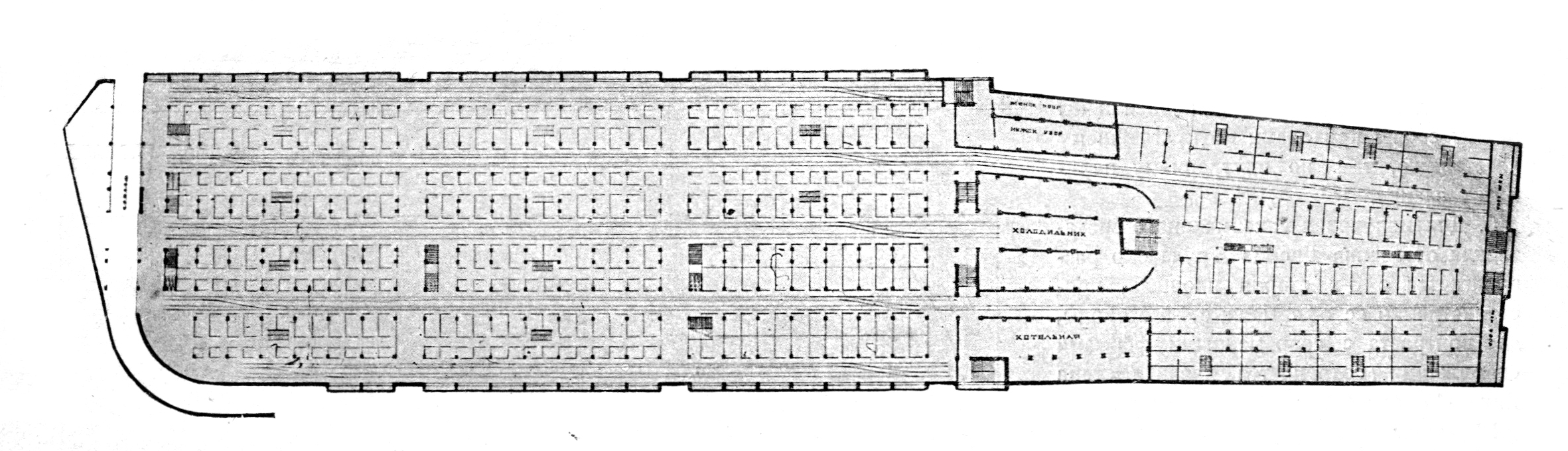
Basement Floor Plan
The two above-ground levels are brightly lit with long, barrel-vault shaped, glass-and-steel roofs. The blocks of the market stalls are disposed around these five glass roofs with two-story galleries that fill the halls with light. In contrast, light does not penetrate to the basement level. While the basement plan seems to repeat the grid of market stalls from the ground floor, the lack of light makes its use less certain. In plan we can see the curved access ramp for trucks and rail tracks which crisscross down the main aisles. In section, Golosov has drawn these for cargo-carts. These rails and ramp suggest that the lowest level is less for the retail sale of merchandise rather than the loading, unloading, and transport of wholesale cargo. Golosov has not labeled the drawings for us.
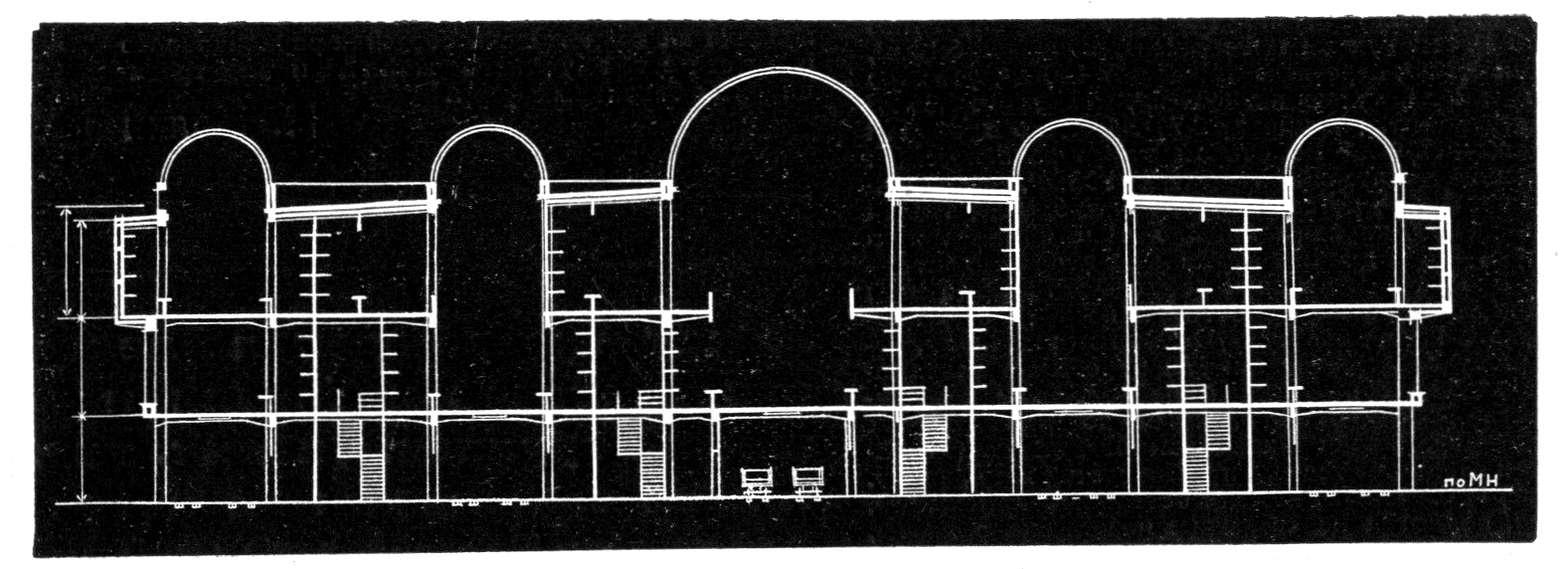
Transverse Section
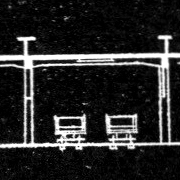
Section Detail: The produce carts on rails
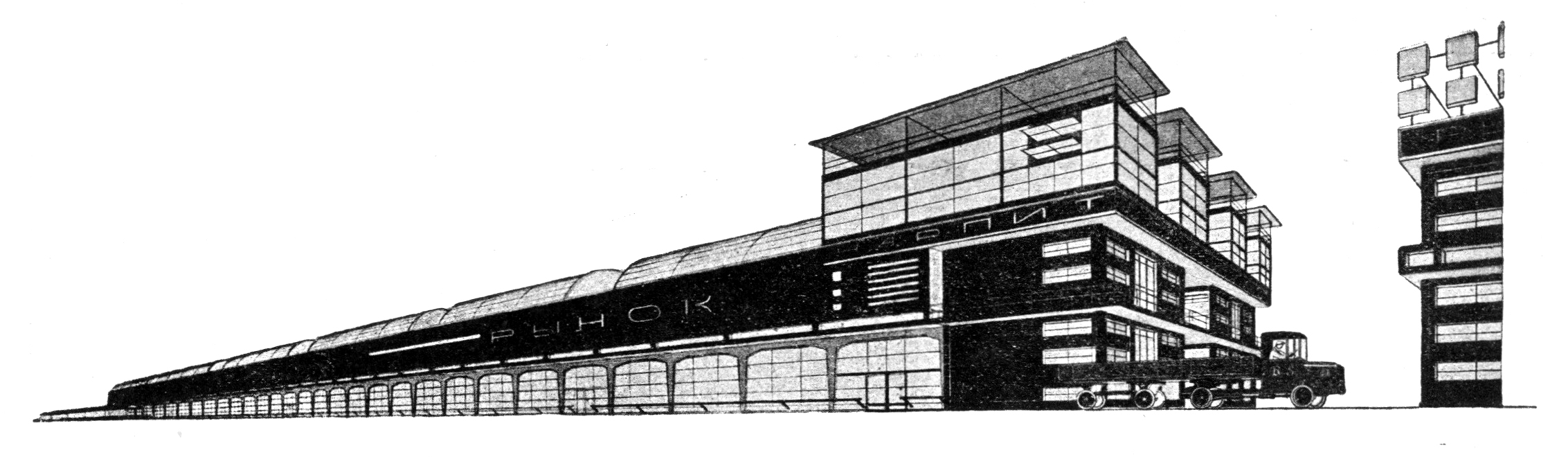
Perspective
A project earlier in the same issue of Contemporary Architecture offers more hints. A diploma project by Mikhail Sinyavsky and Mikhail Barshch offers two designs for a wholesale food market on Bolotnaya Square in Moscow. Here the project text describes the intricate movement of influent produce:
In these projects, special attention was paid to maximum hygiene in the storage and sale of products. Handling and local transport are kept to a minimum, as the produce goes directly from external unloading platforms through sanitary inspection points to the market halls. The sold goods are conveyed through conveyors running under the floor into packaging rooms and places of issue. From there, through hatches in the floor, it is loaded onto cars or carts […] profitability is taken into account both in the construction and operation of a large, free-standing refrigeration base with a special unloading platform, a light connecting corridor-overpass above the market, and a powerful compressor unit that partially cools the market basements.

Plan Detail: Stairs to the basement in the service corridors on the ground floor.
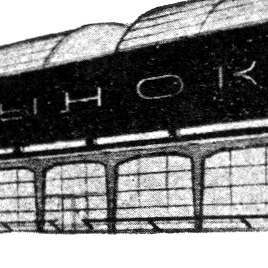
Perspective Detail: Ground floor barrier (at a diagonal) shows that the openings cannot be used for loading & unloading.
Using this description by Barshsch and Sinyavsky of a similar program, it could be fair to say that Golosov had the same sorts of demands for the movement and refrigeration of goods in mind. While the basement occupies over a third of the overall project floor area, we can propose that it was refrigerated zone for the unloading, inspection, and longer-term storage of produce before being moved vertically up to the market halls. The smaller staircases visible in plan (the ones running lengthwise with the building) support this hypothesis as they open into service corridors between the backs of the stalls, allowing for the quick vertical movement of goods. Furthermore, there is no provision for the unloading of goods into the market on the ground floor level. At the ground floor, the perimeter consists of floor-to-ceiling glazing which at first glance hint at operability. In plan, you can imagine trucks parking and passing through this porous barrier, like so many garage doors. However, a closer examination of the perspective shows a kind of metal barrier, both protecting the glazing from truck traffic and guaranteeing that the glazing does not open for cargo.
Smolensky Market Hall (Project) / Ilya Golosov / Moscow, USSR / ca. 1926
 loupeblog.com