
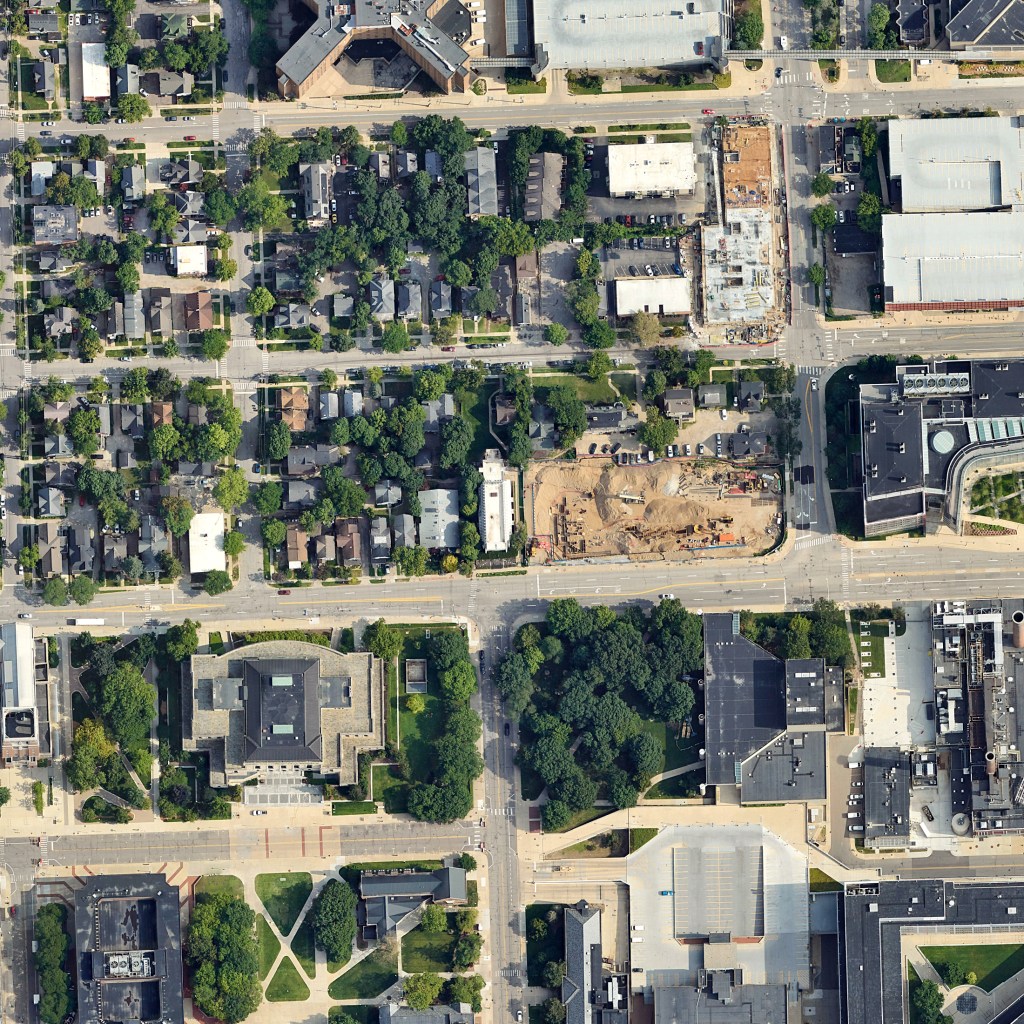
Aerial photo of the church on Huron Street, Ann Arbor (GoogleEarth Image Date: July, 2023)
1964 : Images sourced from Progressive Architecture (September, 1964) with photos by Balthazar Korab (mononymously credited as simply “Balthazar”) unless otherwise noted. Text in italics below excerpted from the same issue, pages 172-172, 186-191.
Progressive Architecture presents the University Reformed Church as one of several projects in a feature on Birkerts, remarkable as he was only half-a-decade in independent pracitice. Each project is accompanied with an identifying gesture typical of Birkerts’ work; for this church, the term is ‘indirect light.’

Ground floor plan, reoriented by editors to place North upward
However strongly these first two jobs differ from the work of Yamasaki, they both retained his Palladian symmetry of plan. Although Birkerts’ approach as a whole has changed little in his last five years of independent practice, he has reconsidered the matter of symmetry, designing a symmetrical building today “only when it is really called for.”
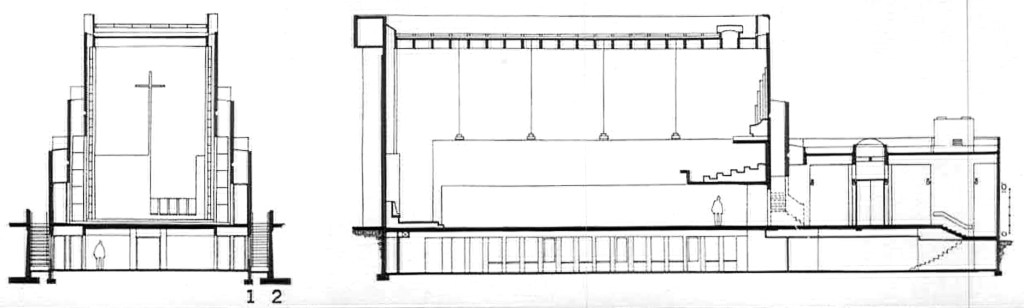
Transverse section facing the altar and longitudinal section facing West
The nave of the church is enclosed by a three-dimensional composition of planes that incorporates both structural support and sources of daylight. A series of poured concrete betns runs the length of the space, rising in steps from the bearing walls along either side up to the level of the roof. Poured concrete fins at 4-ft intervals act as stiffeners for the exceptionally deep, narrow sections of the bents. The engineers’ analysis reveals that the entire honeycomb structure behaves in a complex way, with the fins and the precast roof beams forming a transverse arch, but the longitudinal bents carry substantially the entire load.
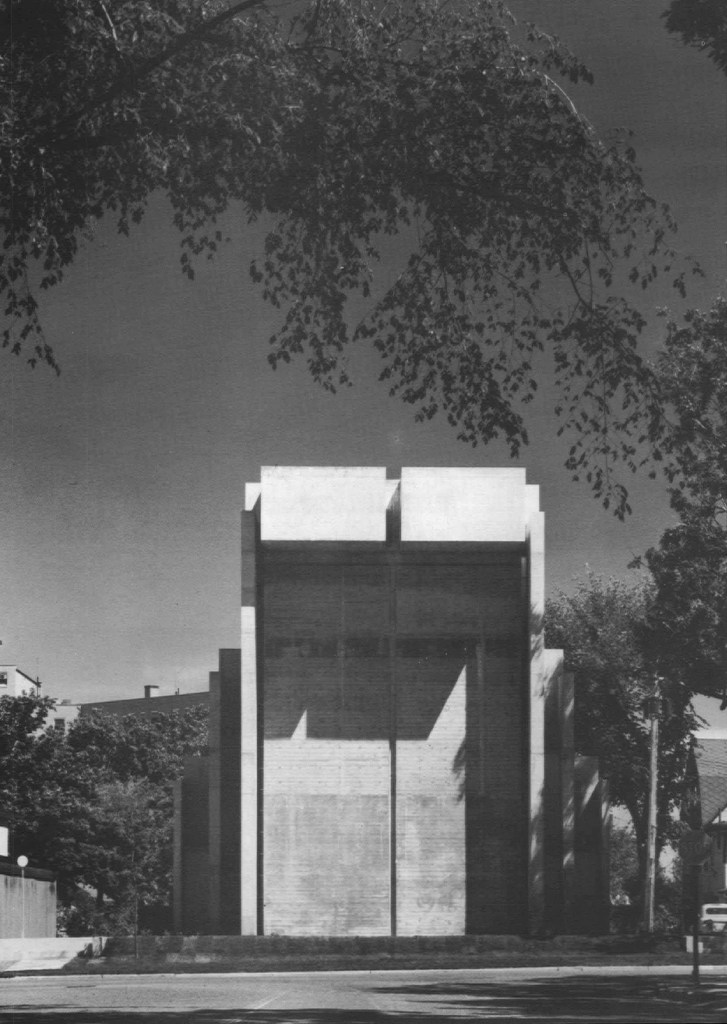
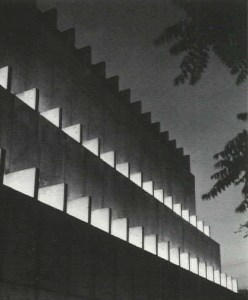

Birkerts’ first works as an independent architect showed a definite reaction to the increasing delicacy of Yama’s work at that time. Gunnar was finally able to fulfill a desire to build plain, solid walls, pierced by strongly articulated windows.
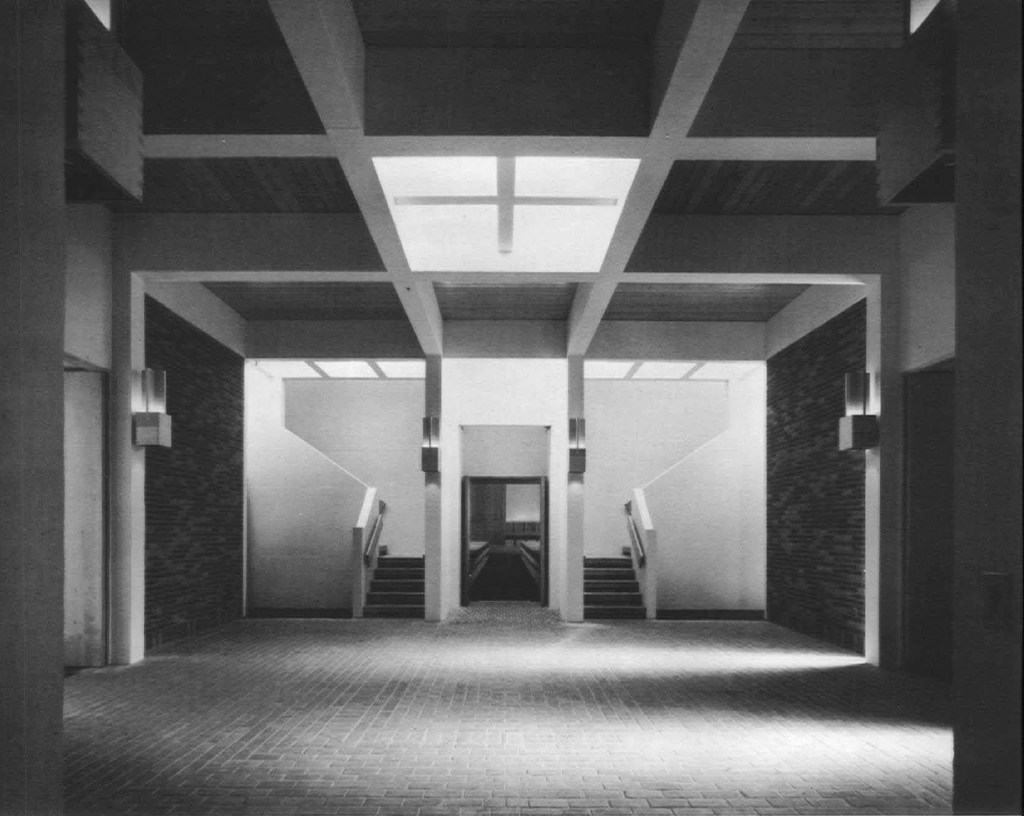
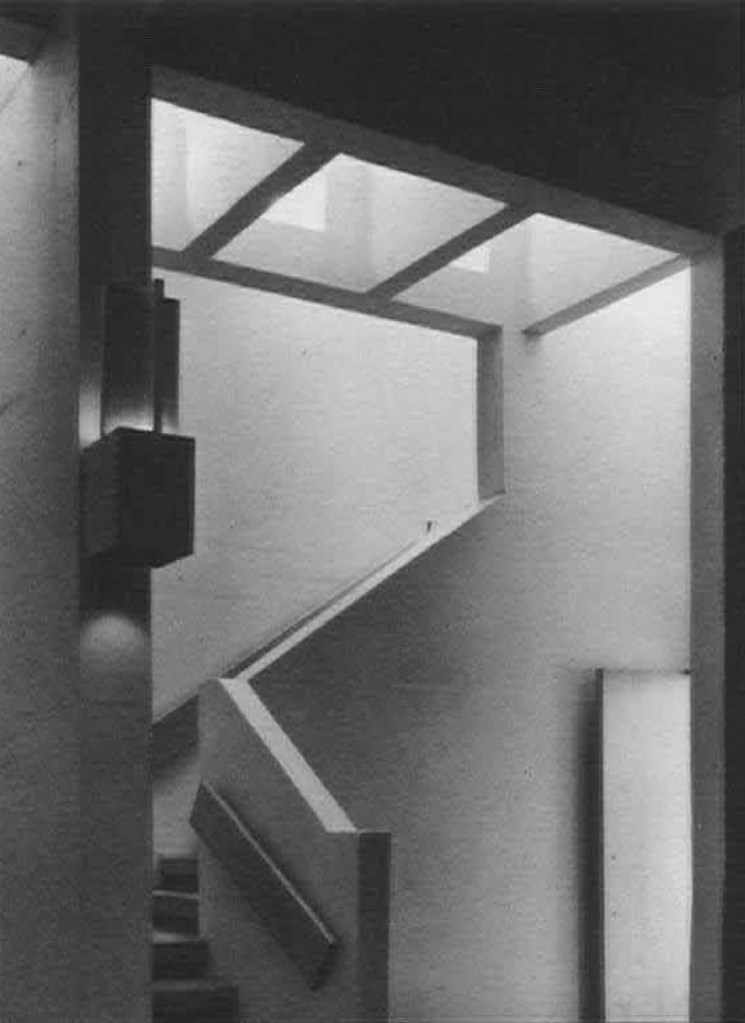
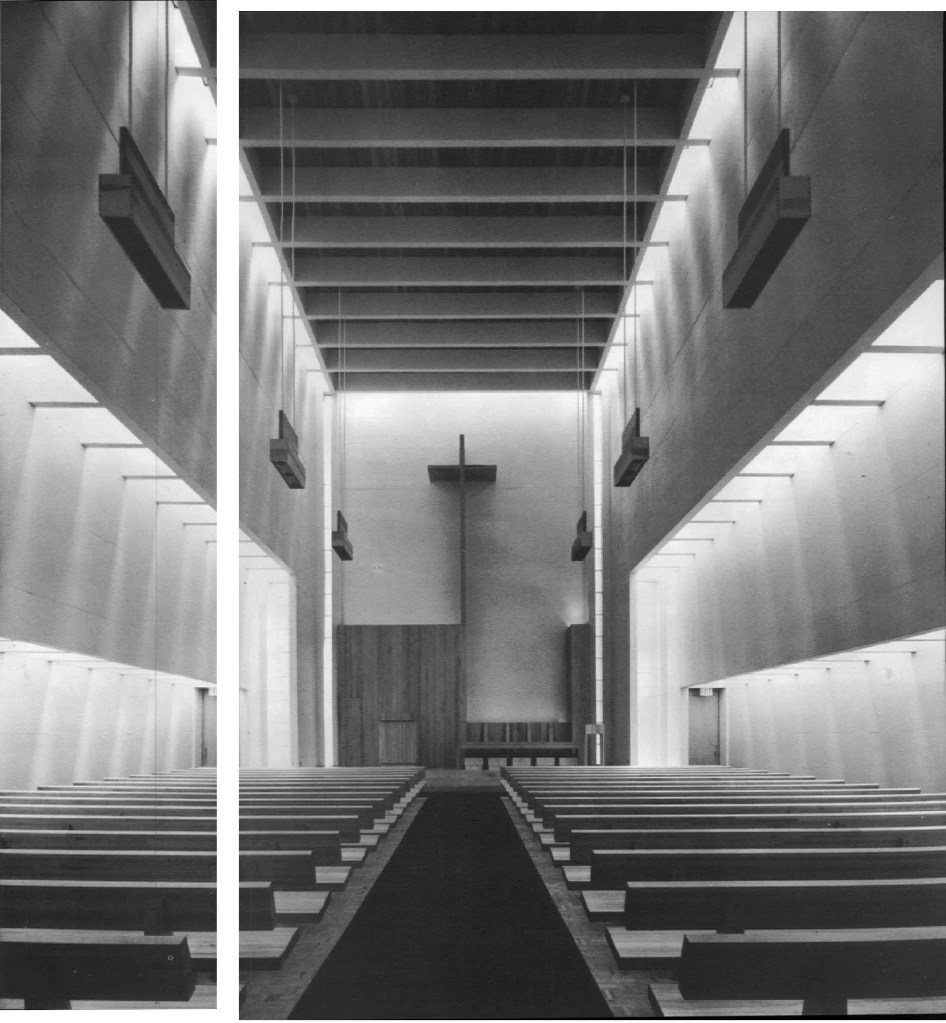
Artificial lighting is designed to emanate mainly from the same [natural] light sources. Bare incandescent bulbs in each cell of the structural honeycomb illuminate both interior and exterior. The lack of lighting for the top tier of fins on the exterior – attributed to the difficulty of re-lamping at that height – leaves the building form inadequately defined at night. Inside the nave, supplementary lighting is provided by suspended fixtures over the seating are and up-lighting on the chancel wall.
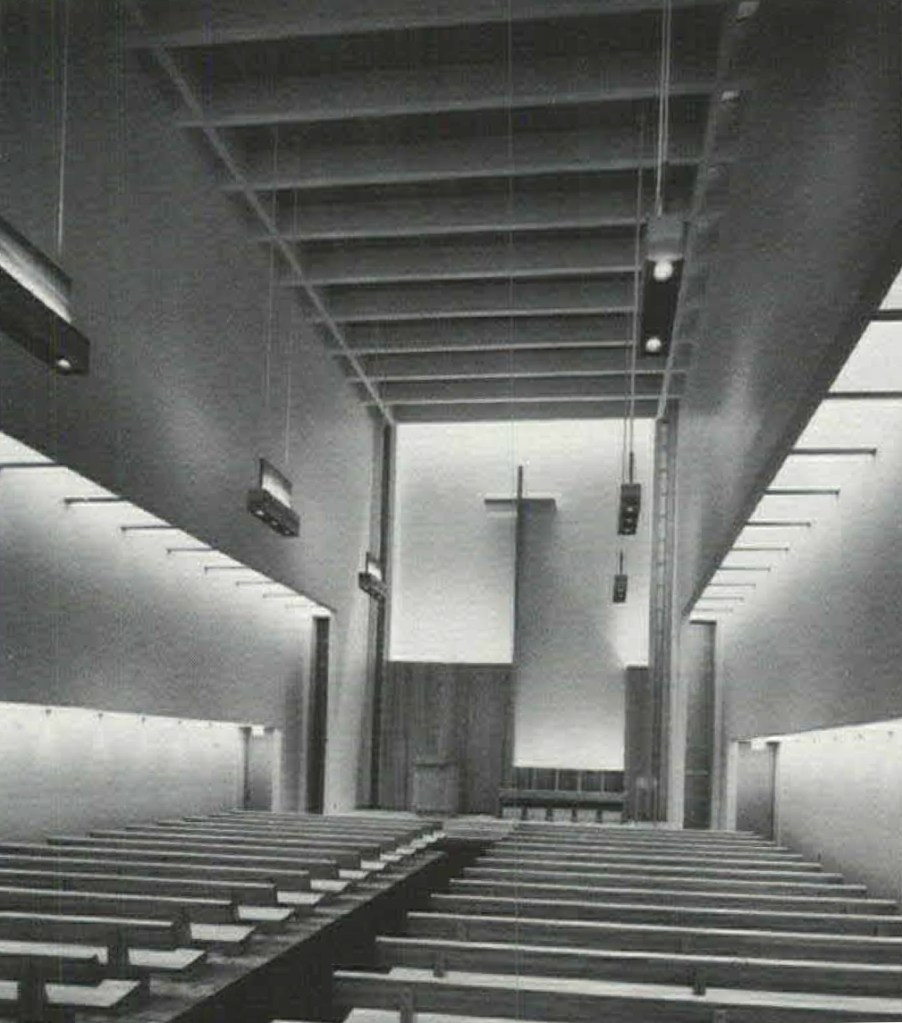
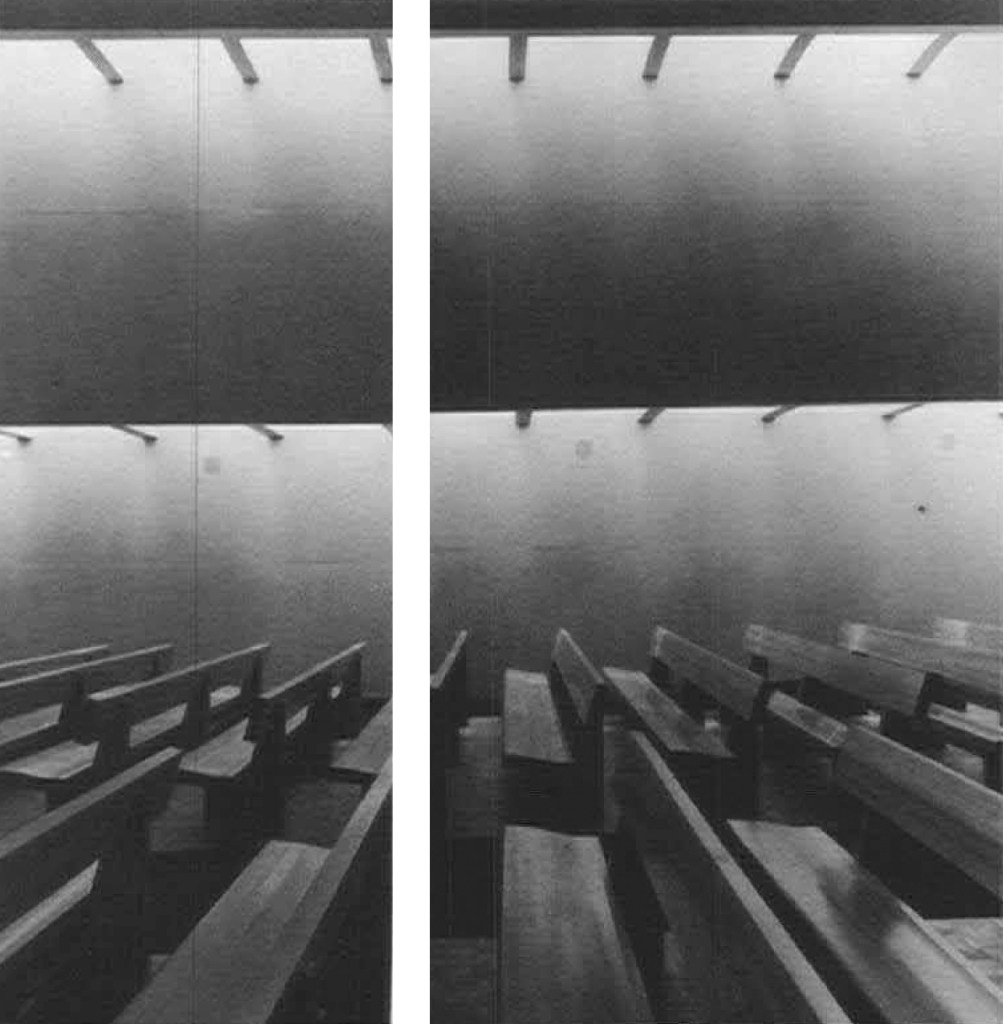

The predominantly hard surfaces and large volume of the nave make it somewhat too reverberant for good speech intelligibility, especially when the pews are not filled. It has proved excellent for instrumental groups, however.
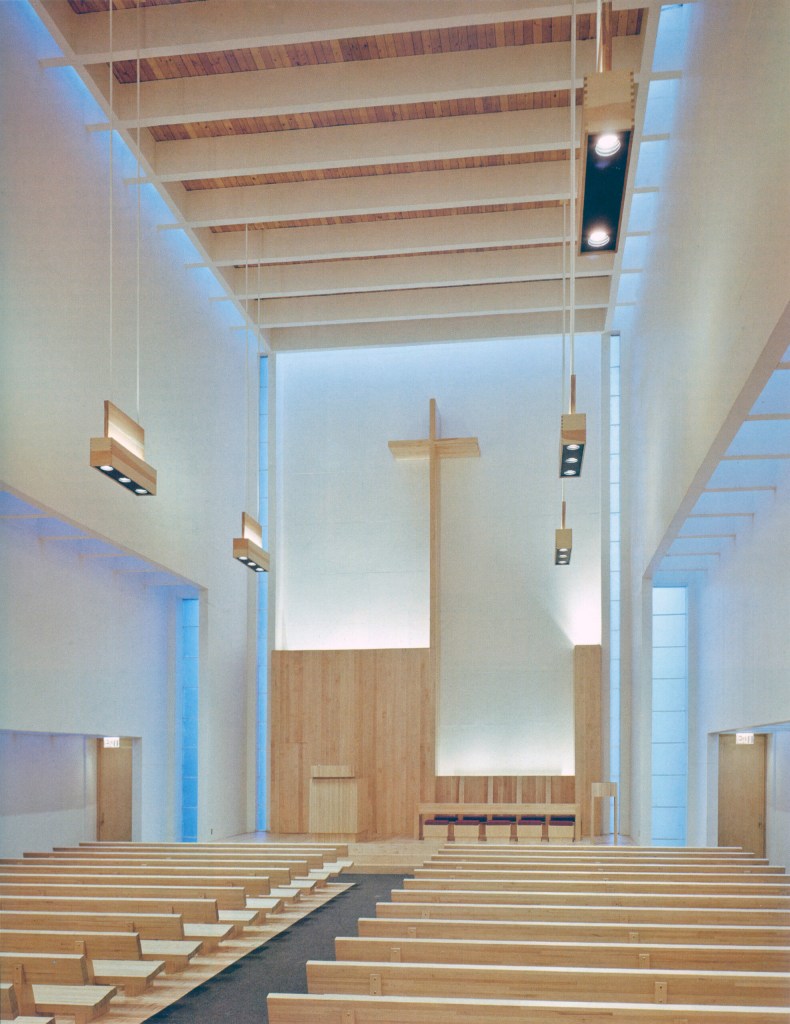
Color photo of the nave by Balthazar Korab (Not sourced from PA but rather the faculty page of Michael Abrahamson, editor, historian, and professor of architecture at the Univ. of Utah, and author of an upcoming book on Birkerts and the evolving bureaucracy of architectural practice after mid-century. As the church is not among those projects digitized by the Library of Congress’ Korab Collection, Loupeblog is much obliged.)
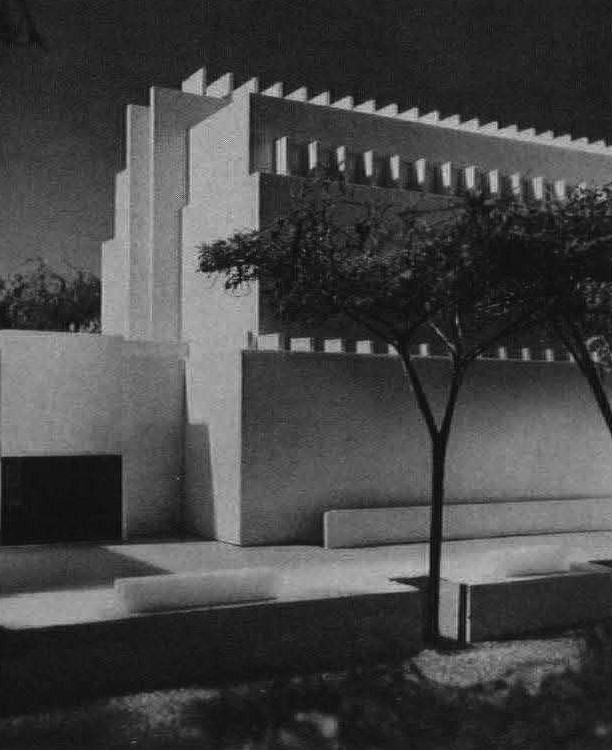
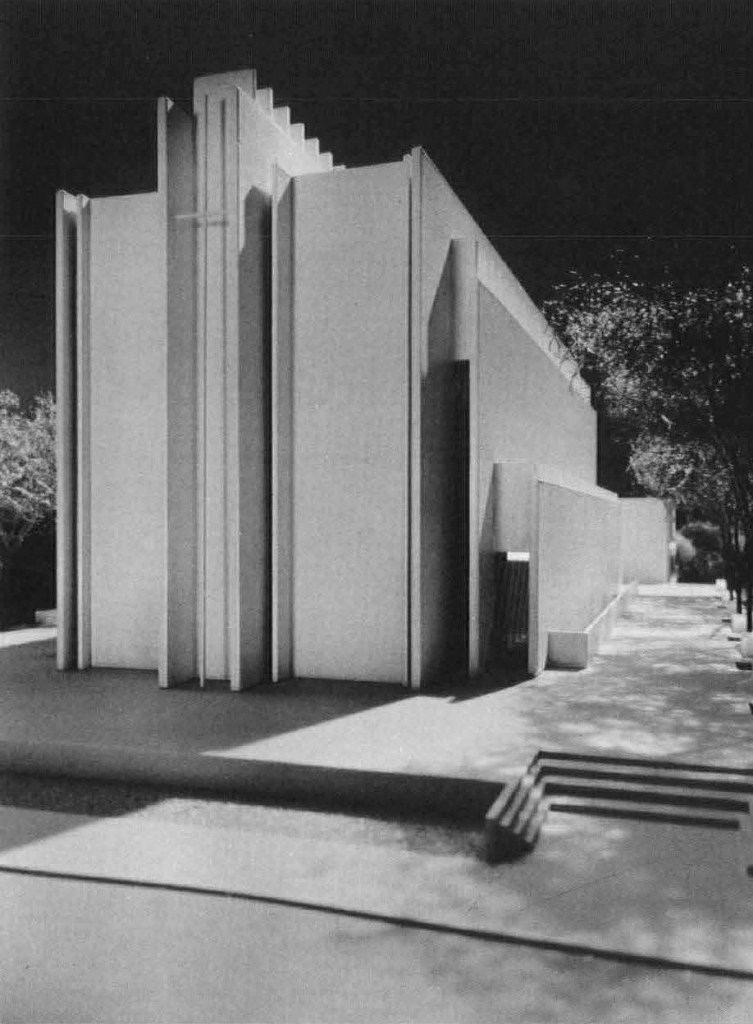
1961 : Images sourced from Progressive Architecture (December, 1961) with model photos by Balthazar Korab. As the church was originally published as a project, it’s a lucky case study being able to compare the schematic and finished design. The 1961 issue featured contemporary church designs.

Ground floor plan (North is downward) with unbuilt classroom wing

Section perspective looking Southward toward the altar
In this original scheme, the central nave bay is lit by a long dorsal skylight. This more intensely emphasizes the church’s axis of symmetry. It also deviates from the lateral skylights which are formed by the gaps between walls, diffusing light along their length.


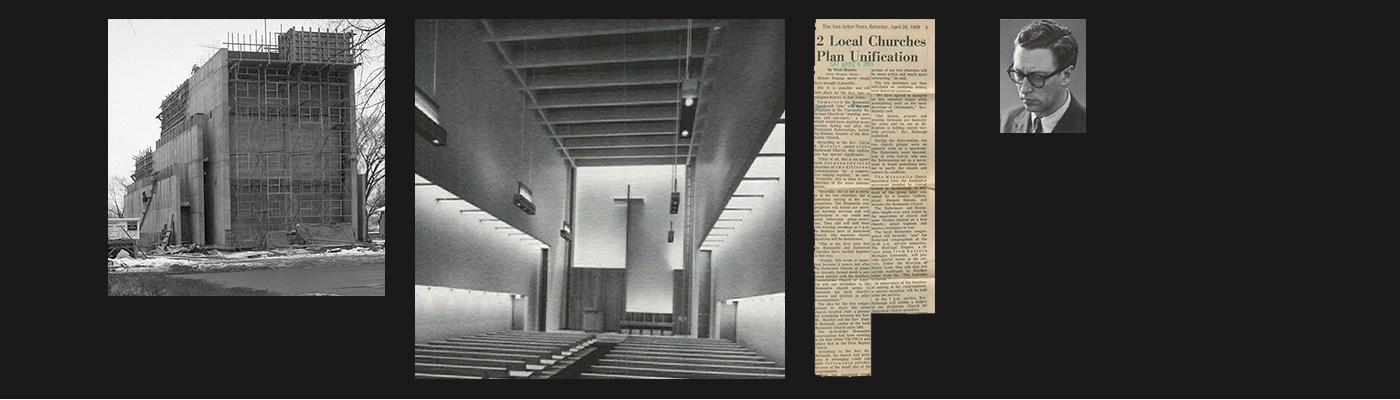
1963-1964 : Construction photos sourced from the Ann Arbor District Library archive of the Ann Arbor News
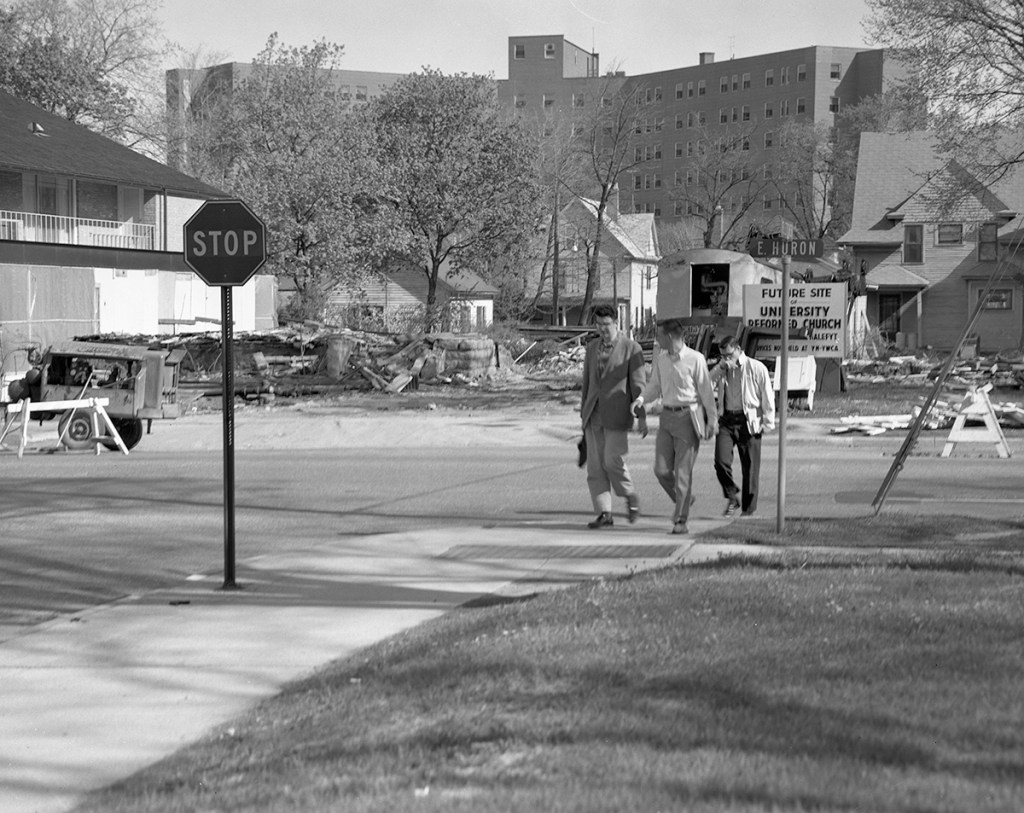
Site for new University Reformed Church (Photo: Eck Stanger, May 1963)

Photo: Eck Stanger, December 1963
The concrete exterior was originally intended to have the texture of board formwork, but even that proved too expensive, and 4’x8’ plywood sheet, plastic coated, was used instead, except on the front wall and the narthex parapet. Cold-weather pouring resulted in uneven color, despite precautions. Choice of a corrective treatment is still being considered. (Progressive Architecture, September 1964, p190)
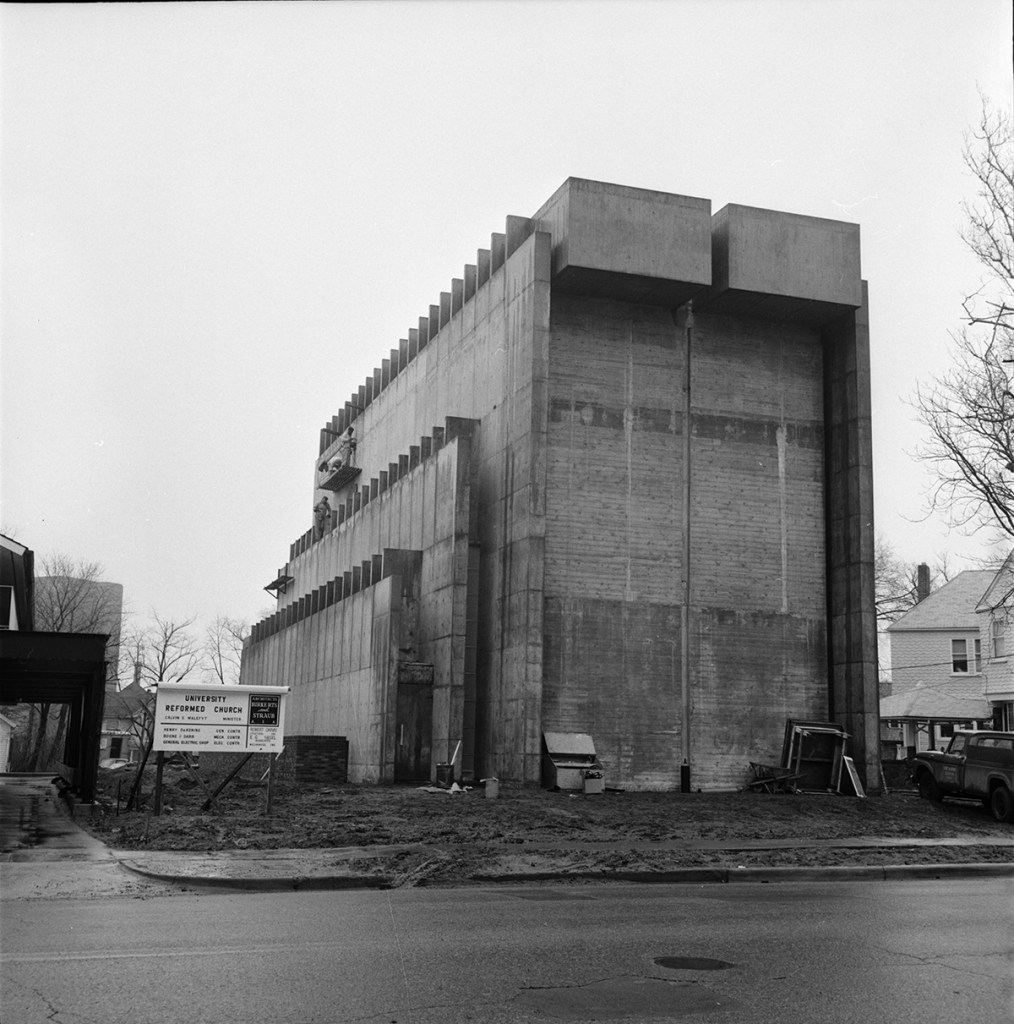
Photo: Duane Scheel, April 1964
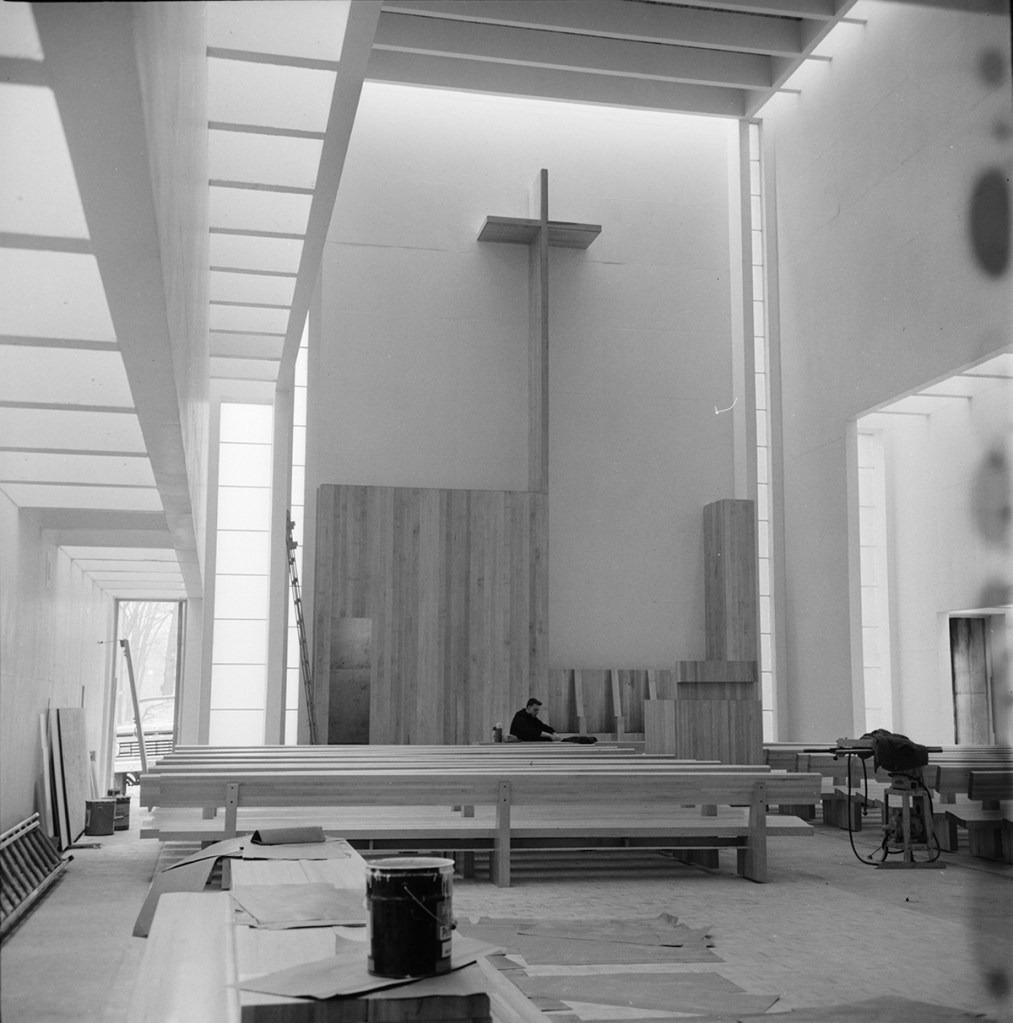
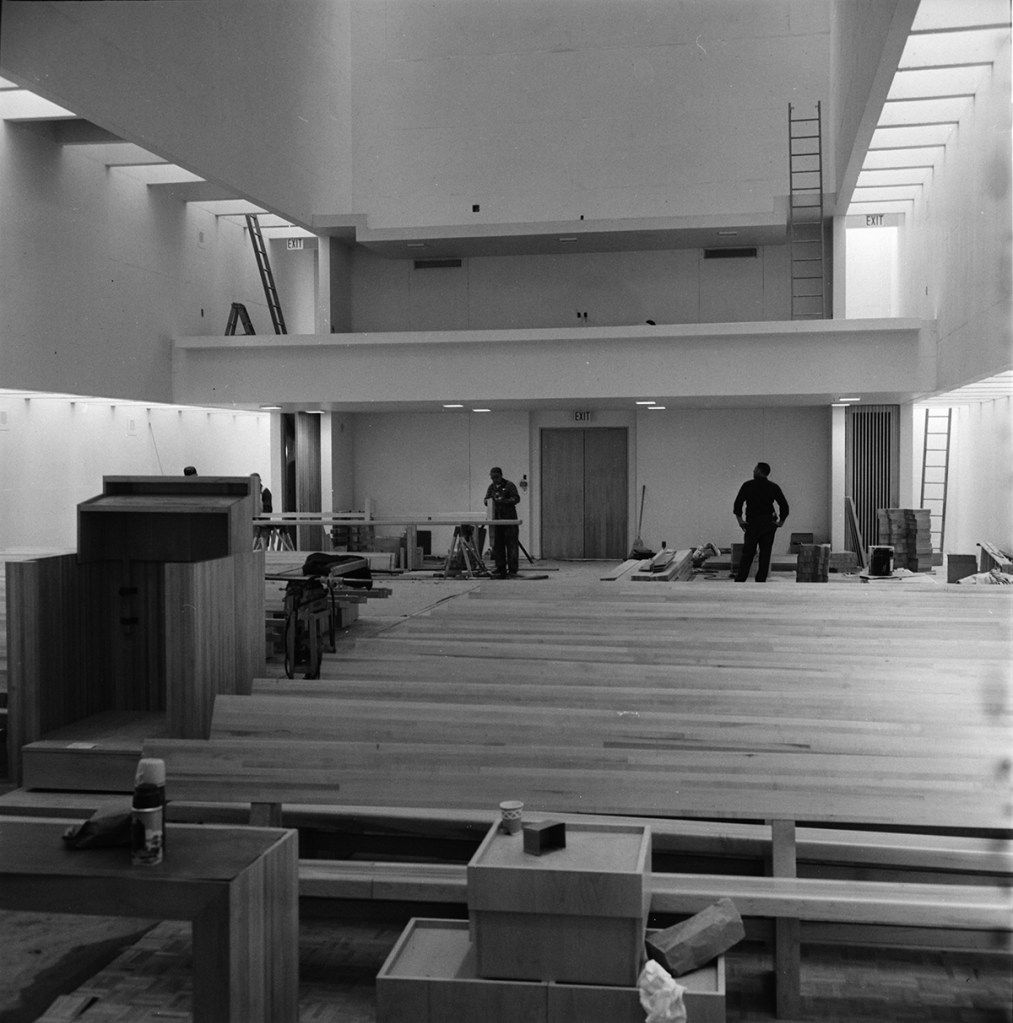
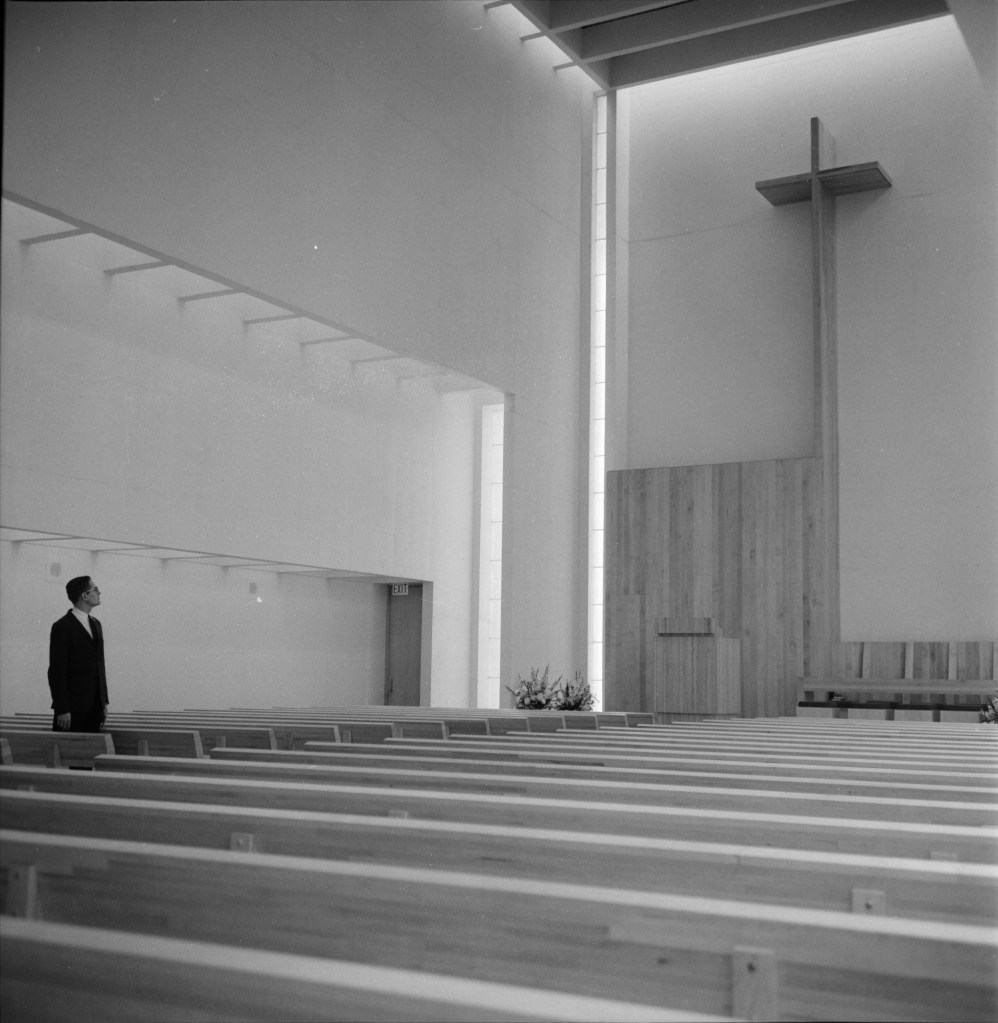
Photos (3x above): Duane Scheel, 1964
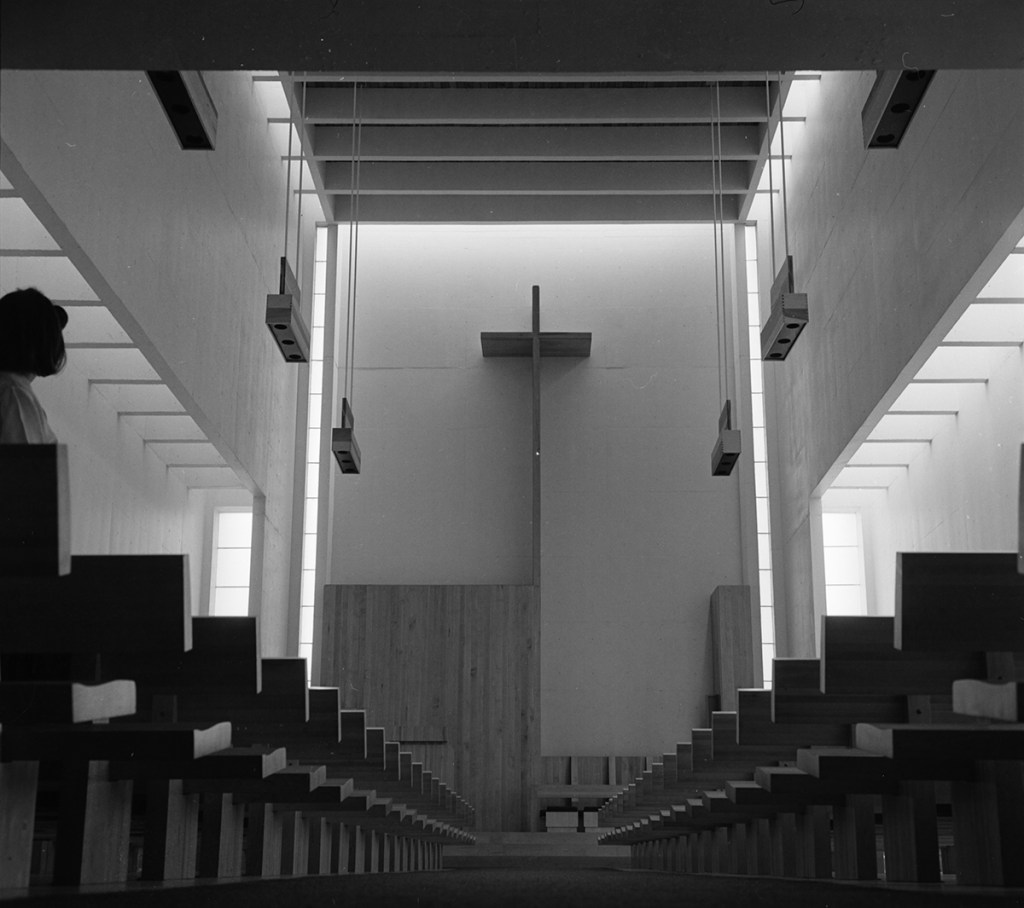
Photos: Doug Fulton, April 1965
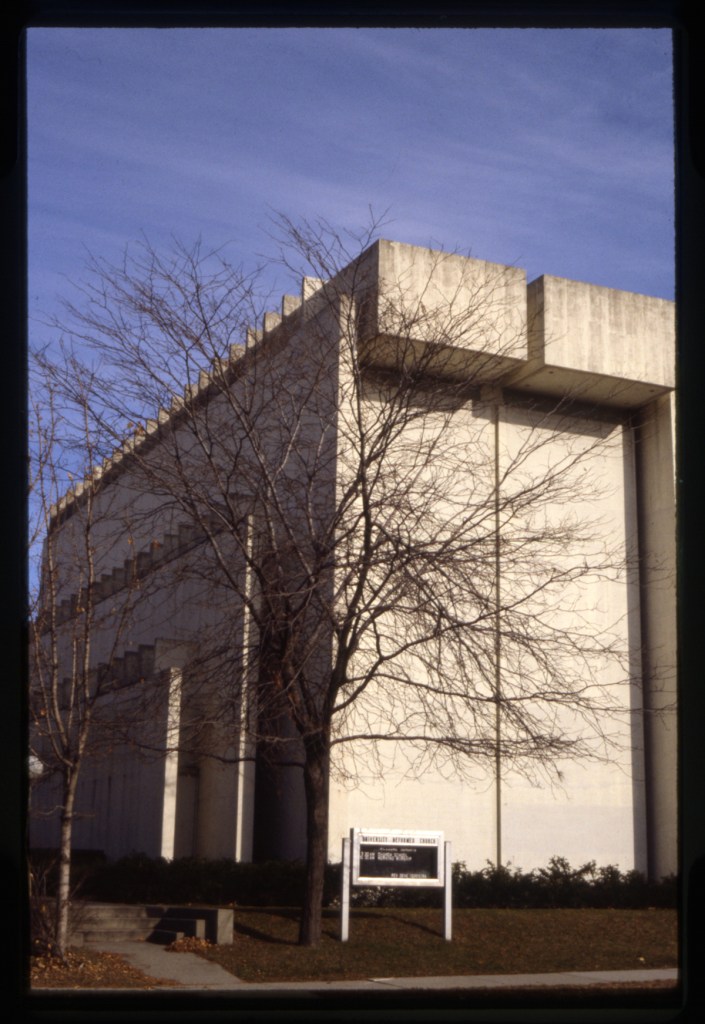
Photo: Susan Wineberg, 1981
After 1981, Loupeblog cannot ascertain when the University Reformed Church moved out of the Birkerts building. By 2009, the building was inhabited by the Harvest Mission Community Church, a non-denominational congregation. According to statements on the Church’s website, they saw the potential in appealing to adjacent university students, much like the original Reformed congregation. Regrettably, the new occupants have the committed the unforgiveable sin of covering up Birkerts’ divine skylights in order to create a black box for their stage lighting and broadcasts of mass.
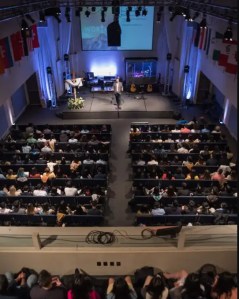
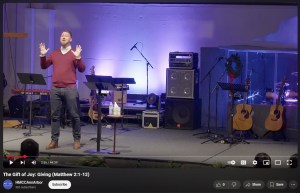
Screenshots (2x above) from Harvest Mission Community Church website and YouTube channel.
It “was named Holy Toaster because of its slab-sided design,” says Terri Klein Gordinier. For Kevin Berasley, it “was one of the first landmarks I learned after moving” here. But it didn’t work as a landmark for Mary S. Roth, who lived nearby. “Somehow that building is so huge and ugly that it becomes invisible,” she writes. Julie Ellis offers another theory: that it is “overlooked due to the distraction of all the inflatables at the Bed & Breakfast next door. (Ann Arbor Observer, May 2021)
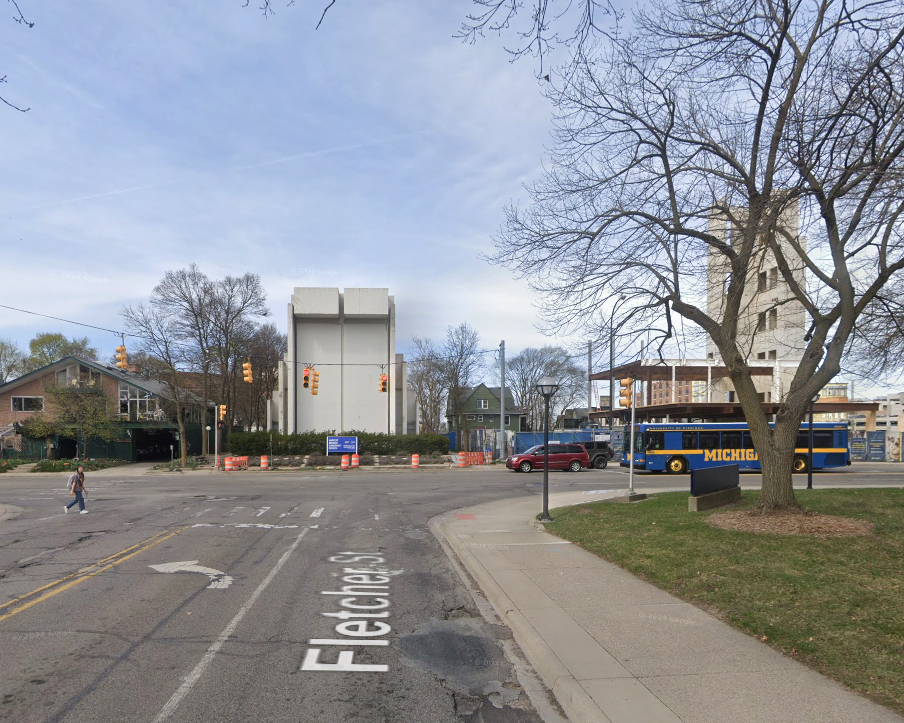
The houses to the East of the church have recently been demolished for construction of the Univ. of Michigan’s Pharmacy School Building. While the original church may have seemed a trifle out-of-place upon its original construction, the concrete stair core of the future building now dwarfs the church.
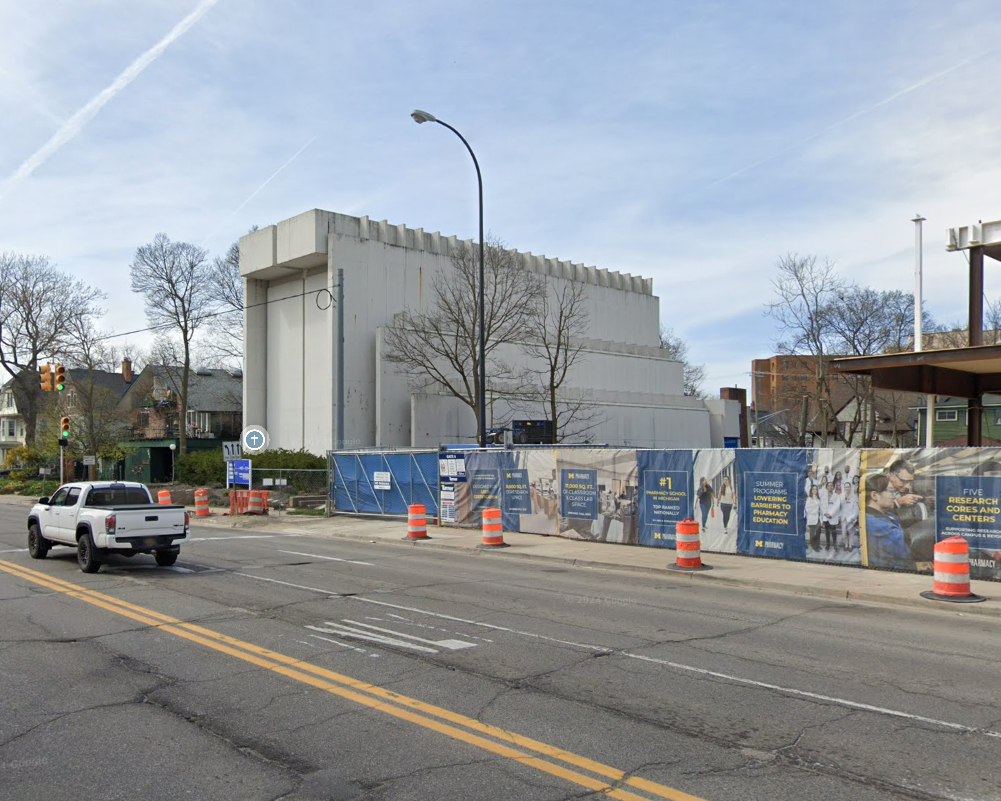
Street photo (2x above): Google Streetview, April 2024

Photo of inflatable Christmas decorations from the website of the neighboring Ann Arbor Bed & Breakfast with Church in Background

Cover of Progressive Architecture (September 1964) showing the parapet of the South facade at dusk
University Reformed Church / Birkerts & Straub* / Ann Arbor, Michigan, USA / (design begun 1961-) 1964 / Structural Engineer: Robert Darvas & Associates / Mechanical and Electrical Engineers: E.G. Siegel Associates / Landscape Architects: Johnson, Johnson & Roy / General Contractor: Henry de Koning Construction Company
*Partnership with Frank Straub dissolved in 1963
 loupeblog.com