
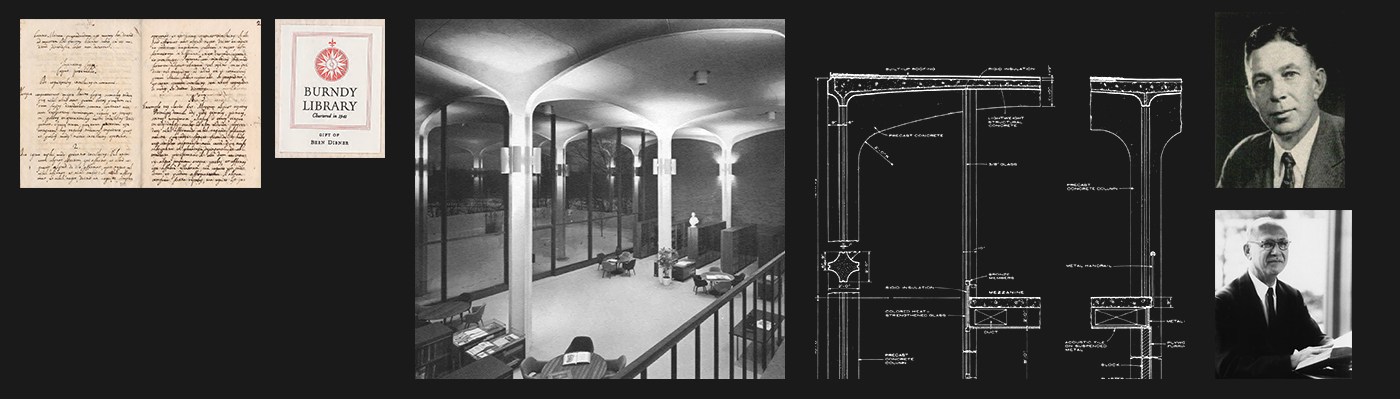
In 1941, electrical engineer and industrialist Bern Dibner founded his library of rare, historic books on science and technology. This collection included manuscripts by Louis Pasteur, 16th-Century editions of Archimedes, and books from annotated Newton’s own library. The self-invented name ‘Burndy’ is a portmanteau of Dibner’s own name. In 1974 a portion of his collection was donated to the Smithsonian, and the rest to the Massachusetts Institute of Technology following his death in 1988. Later in 2006, MIT transferred their portion of the collection to the Huntington Library in California. While his collection was still together, he commissioned the construction of this building to house it. Sherwood, Mills, & Smith were competent practitioners in the Connecticut suburbs, so their acquisition of the commission is easy to imagine.
Note: Using public satellite imagery platforms, the editor searched along relevant commercial and industrial streets in Norwalk to find the building, but could not. The building is presumed no longer extant. Frankly, taking one look at the wall section you can see why this handsome, little structure was climatically unfit for such delicate volumes.
Text excerpted below in italics and photos reproduced from Progressive Architecture (September, 1964). Photos by Ezra Stoller Associates.
This library houses a unique collection of rare books, manuscripts, and journals which record the development of the physical and biological sciences from earliest times. The material was assembled by Bern Dibner, the founder of an electrical equipment manufacturing company, who now heads the library. It was his particular wish to make the collection available to the public, not in the form of a museum, but as a working historical library where Plinius’ Historia Naturalis, for example, could be studied in its original version […]
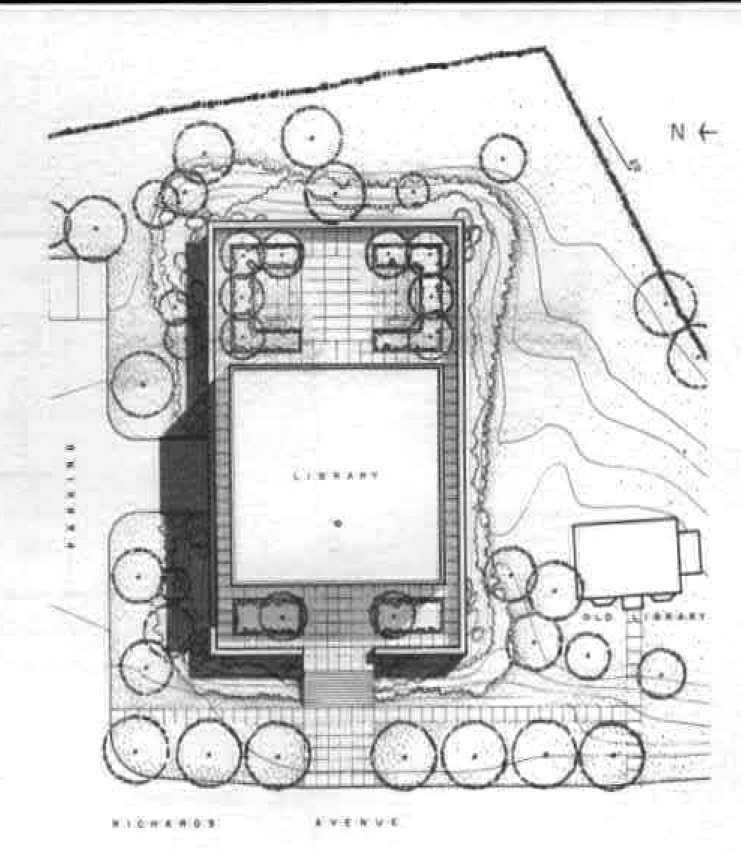
Site Plan
The atmosphere of the library was to be dignified yet friendly, and the interior climatic conditions to be carefully controlled for human comfort and for the preservation of the valuable treasures.
In order to shield the building from nearby industrial structures, from busy road and parking areas, the building has been raised on a rocky plateau, and, for additional privacy, surrounded by a 5-ft garden wall.
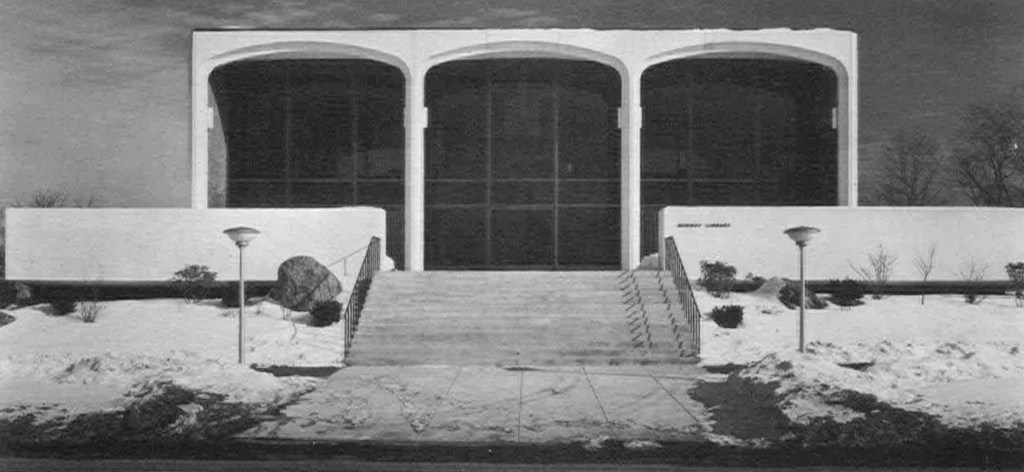
The building itself is a simple pavilion composed of nine square-bayed reinforced concrete vaults which defined one large interior space. Brick panels fill in the vaults along the north and south. The east and west facades are of 3/8” heat-absorbing, solar-bronze glass, set back 9 ft from the building line. Entry to the building is from the west between a row of offices and beneath a mezzanine devoted to the display of early electrical apparatus. The central portion of the main reading room is left open so that it can be set up for lectures […]
Lighting is largely indirect, using the overhead vaults as a source of reflected light and the curved shapes of the cruciform columns to carry light down to the floor level.
Construction of the 12,000 sq ft library was $370,000 […]
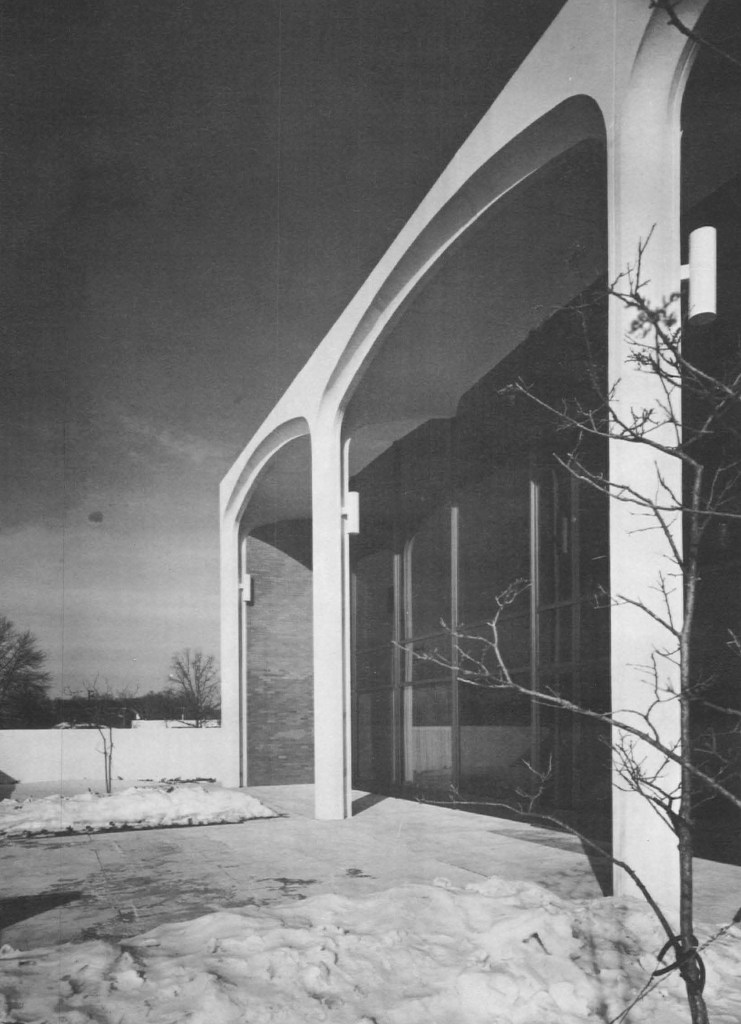

Of primary structural interest are the reinforced concrete vaults, which were erected in three steps: ceiling panels of about 3-in. thickness were precast at ground level; then placed at the desired height; and roof slap poured over the precast panels. Advantages were the repetitive use formwork for standardized precast panels; minimum need for falsework to hold precast panels in position, while roof slap was poured; and use of the precast panels as formwork for the roof slab. Columns with integrated vents and roof drains were also precast. To conceal minor imperfections and discolorations, all concrete surfaces received a final thin spray coat of white cement.

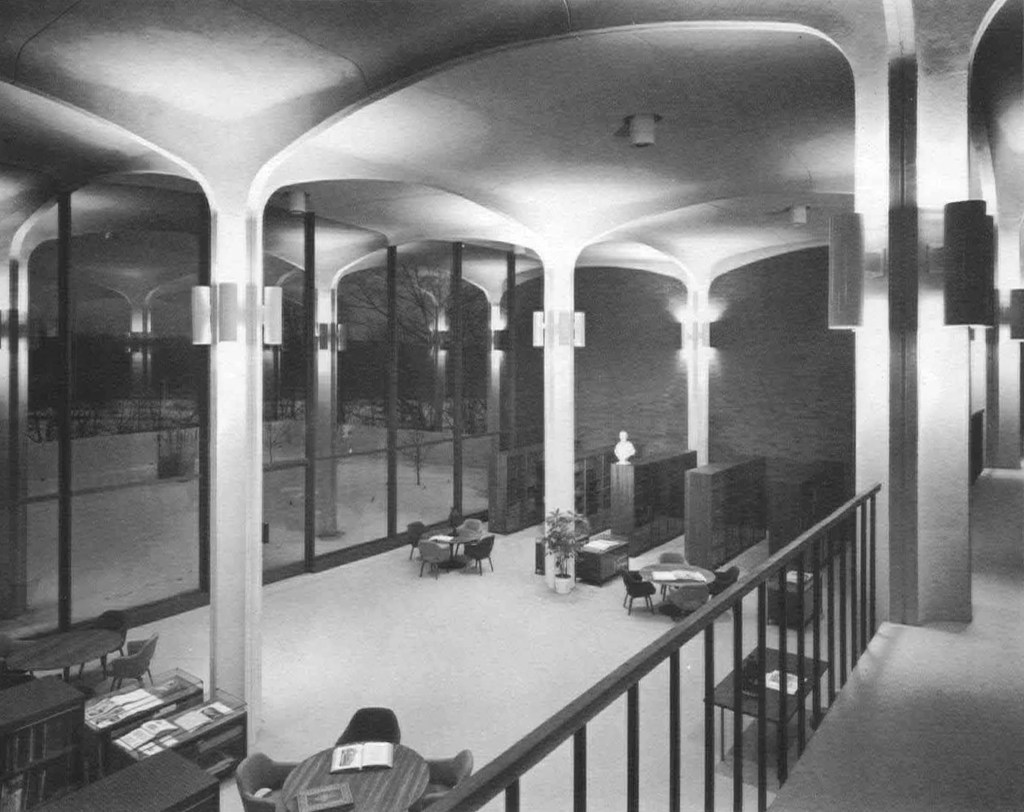
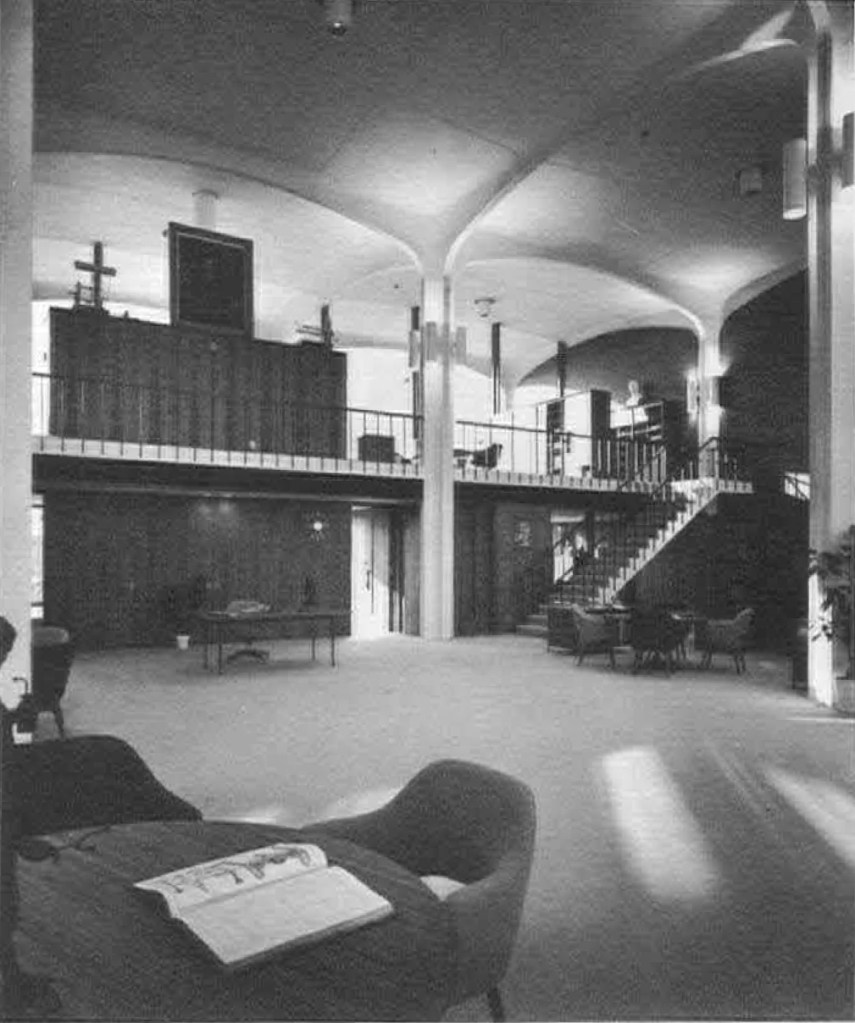
Burndy Library / Sherwood, Mills, & Smith, Architects (Partner-in-Charge-of-Design: Willis N. Mills) / Norwalk, CT, USA / 1964 / Designer: Robert Rogus / Interior Designer: Francis Wilson / Lighting: William Lam / Landscaping: George Cushine / Structural Engineering: Henry Pfisterer / Mechanical Engineering: John L. Altieri
 loupeblog.com