
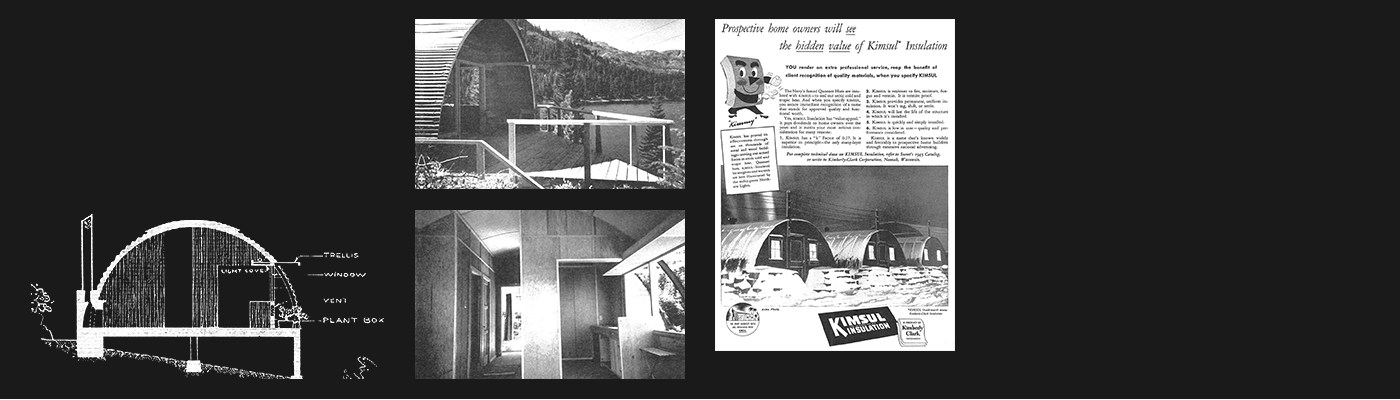
Many of the projects published in Arts & Architecture in the immediate post-war years sought to repurpose war-time techniques and materials. None did so more literally than the Felton Cabin by designer John Campbell and architect Worley K. Wong. Text excerpted in italics and images reproduced below from the original article (Arts & Architecture, December 1946, pp34-35, 50) with photographer unknown:

This particular house was designed for a mature couple with a grown daughter who have traveled extensively and been exposed to many kinds of buildings – old and new. They approached the Quonset idea without prejudice and believed it could be a good solution for their site, if well developed. […]
Let’s look at the Quonset again with a more analytical attitude and an open mind. Let’s stop thinking of the Quonset as a stop-gap emergency shelter or as a poor relation to a real house. To begin with, the contemporary approach to a problem usually evolves from basic forms. (The half cylinder Quonset is on a par then with our more frequently used cube forms.) In this case the pure form is constructed of steel ribs and corrugated metal. Structurally sound and durable, it needs only to be used with honesty, directeness and imagination. Let’s see what we can do with it by contemporary standards. […]

A few key pointers: Keep the form simple. Avoid dormers with orthodox roofs, period balustrades, unrelated forms. The Quonset can be accented with trellises. Side windows can be within the form. Don’t imitate orthodox houses by adding false textures or by furring down the ceilings. Quonsets can be amply insulated. The ribs are designed for four-foot stock panels. […]

Advertisement for Kimsul insulation featuring its application in US Navy Quonset Huts with mascot “Kimmy” (Arts & Architecture, October 1945, p27).
Adapt the Quonset to its site and the climatic needs. Don’t start out with a restricted point of view. Think of it in terms of fullest use. It can be adapted to nearly any site. The relation of form between the Quonset and a fallen tree is a great deal more natural than to the box-cube usually built. […]
Use color and textures suited to the site. Unpainted corrugated metal should be painted to relate to its background. As for texture it is well not to try and overpower the strong bold effect of the corrugation.
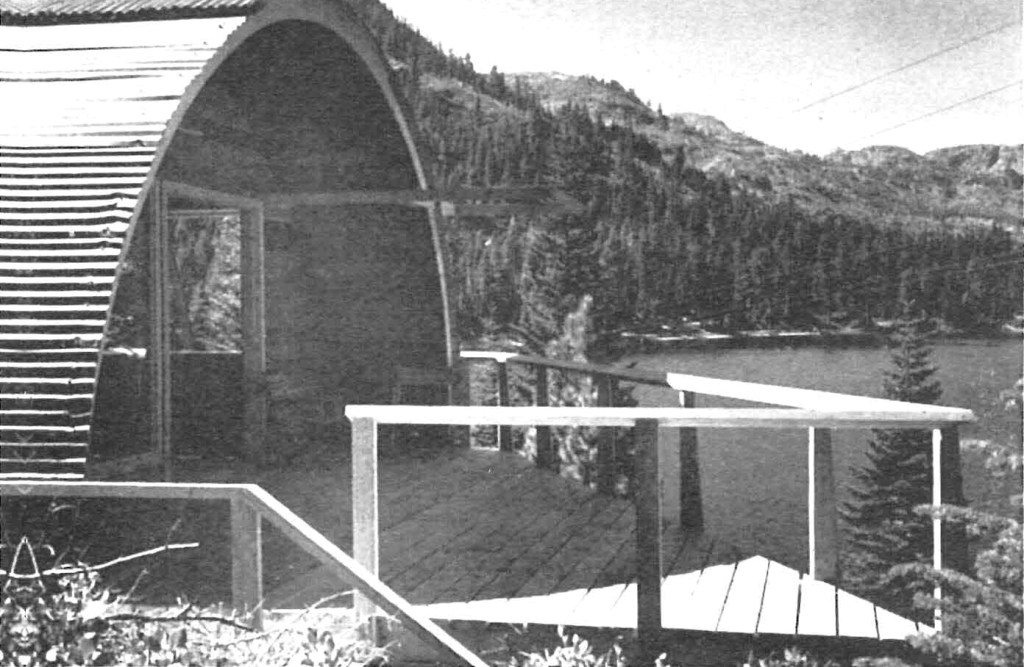
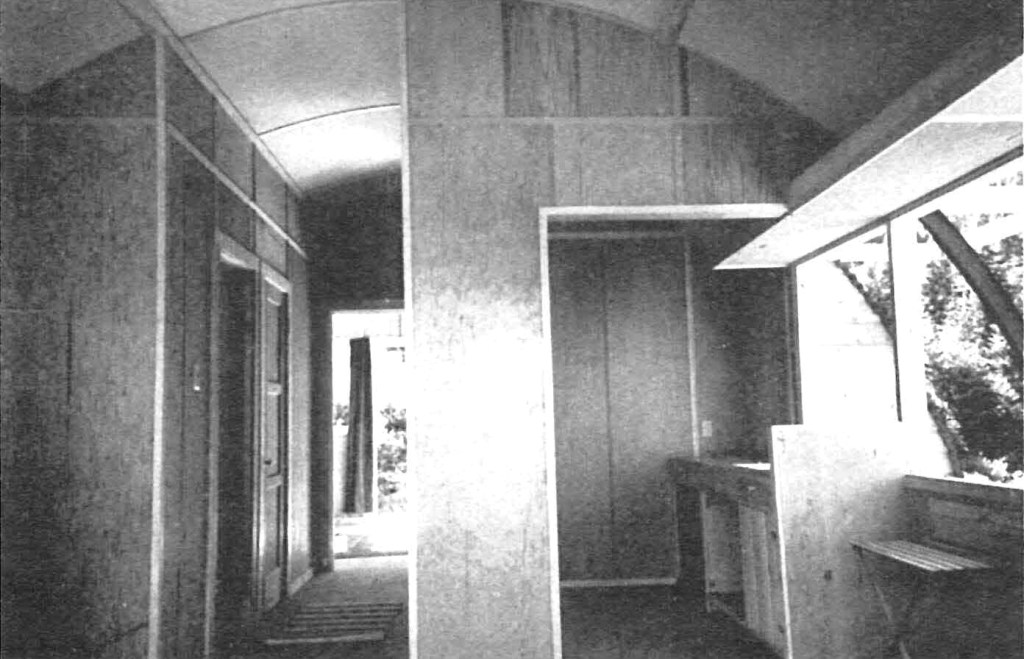
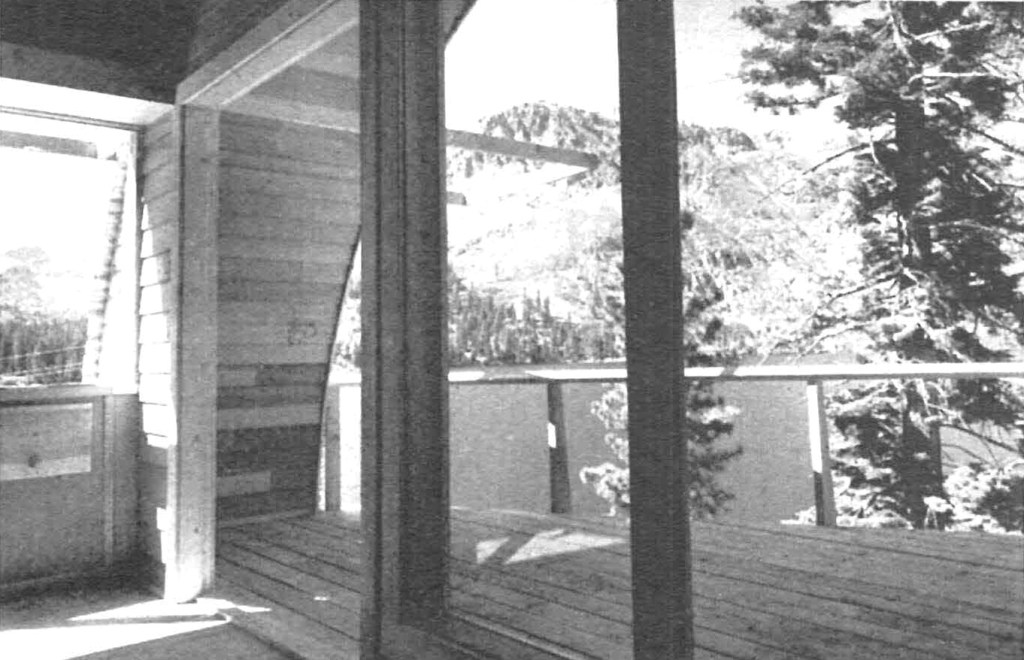
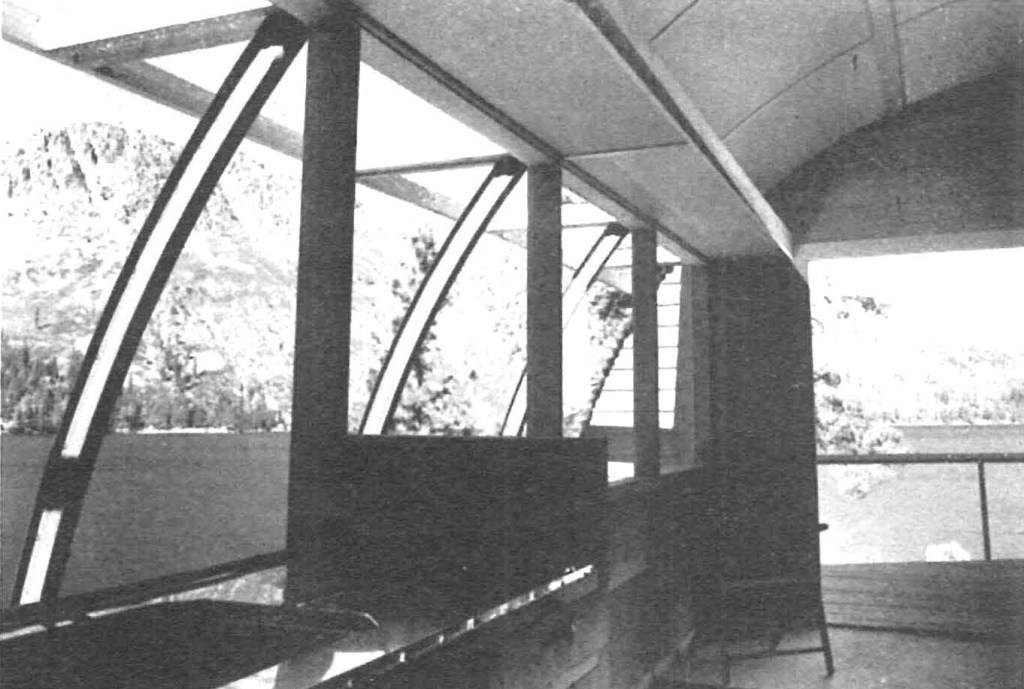
Felton Cabin / Designer John Campbell & Architect Worley K. Wong / Fallen Leaf Lake, CA, USA / 1946
 loupeblog.com